
South-Eastern Finland University of Applied Sciences (XAMK) Industrial Wood Construction Laboratory
XAMK’s Industrial Wood Construction Laboratory provides structural development and testing services on an industrial scale. Commissioned in January 2024, the laboratory serves as an important collaboration partner for companies in the construction industry as well as for research and development projects.
In the Savonlinna region and across Eastern Finland, we can be proud of this significant center of expertise, which enables the research and development of new timber structures and hybrid solutions on an industrial scale.
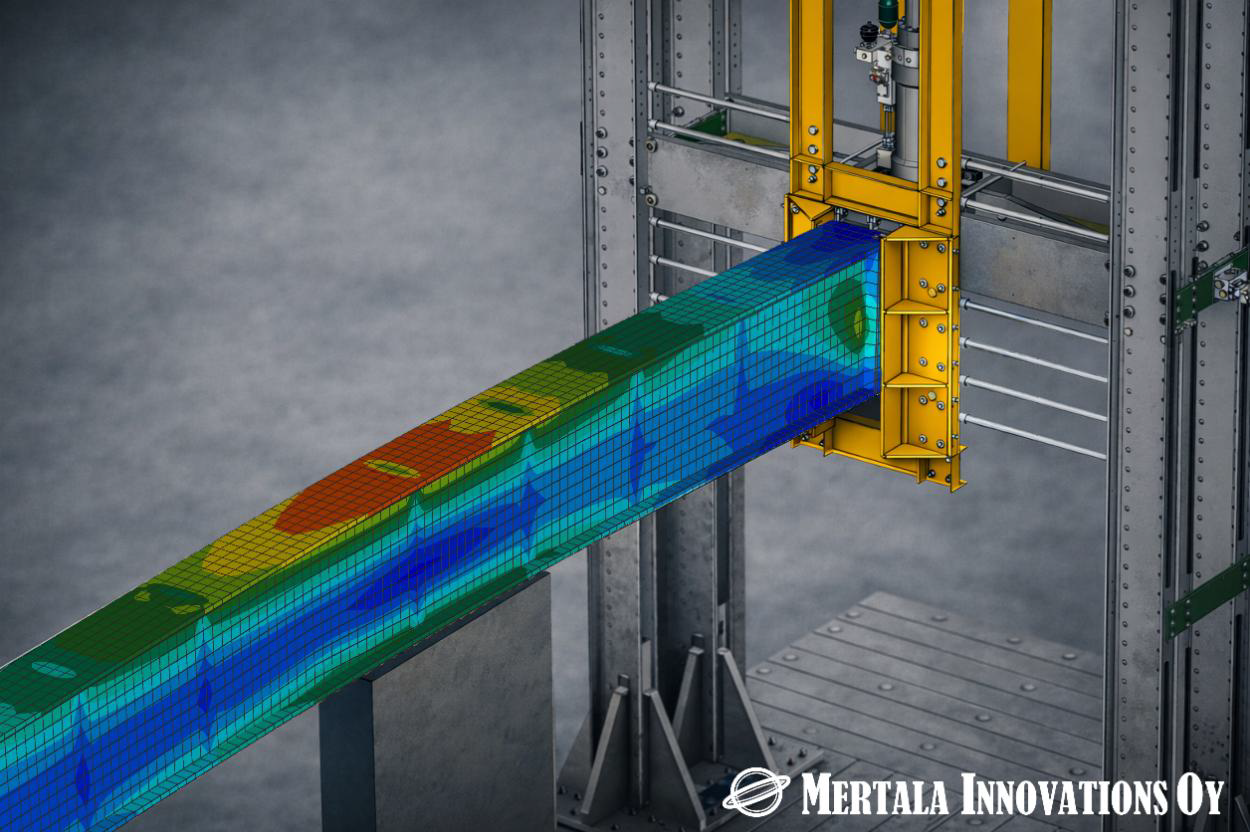
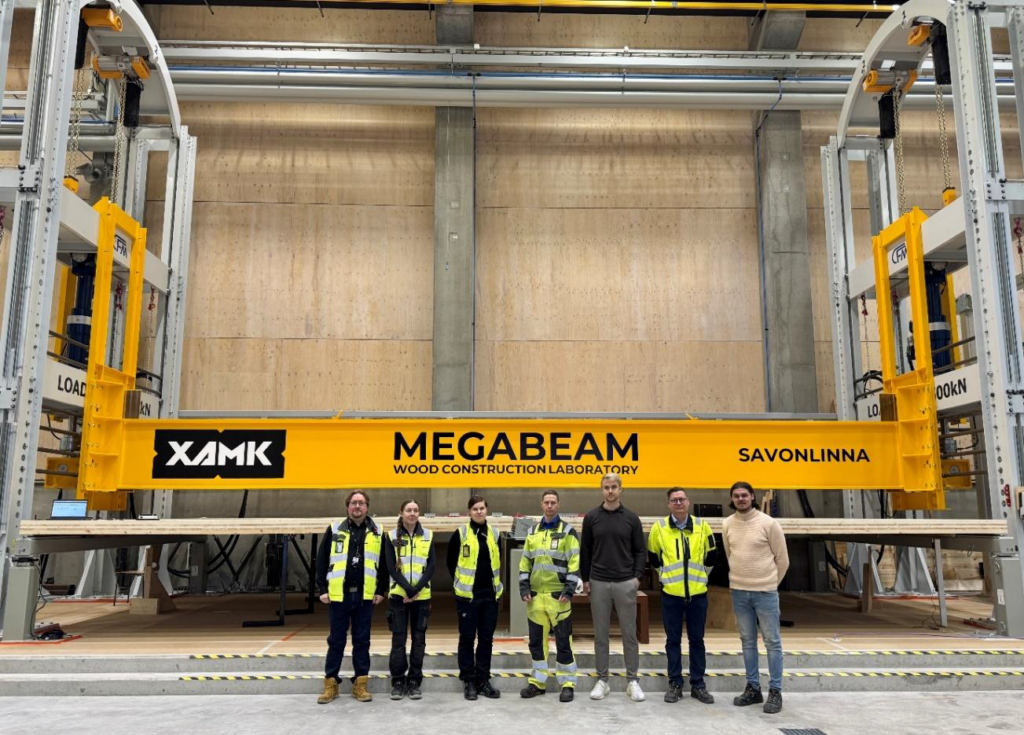
In this customer story, we present a project related to the PuuHyVä initiative, in which Mertala Innovations was responsible for the structural design and strength calculations of a key component of the testing system – a steel load beam. The beam is used, among other applications, in testing hybrid structures utilized in intermediate floor systems.
The testing equipment can apply loads of up to enabling to the structure through the beam. In this project, Mertala Innovations delivered:
- Structural design of the load beam
- Strength Calculation
- Mechanical design of support solutions
- Integration of the overall system into the testing equipment
- 3D models and technical manufacturing drawings
Beam Design Input Data
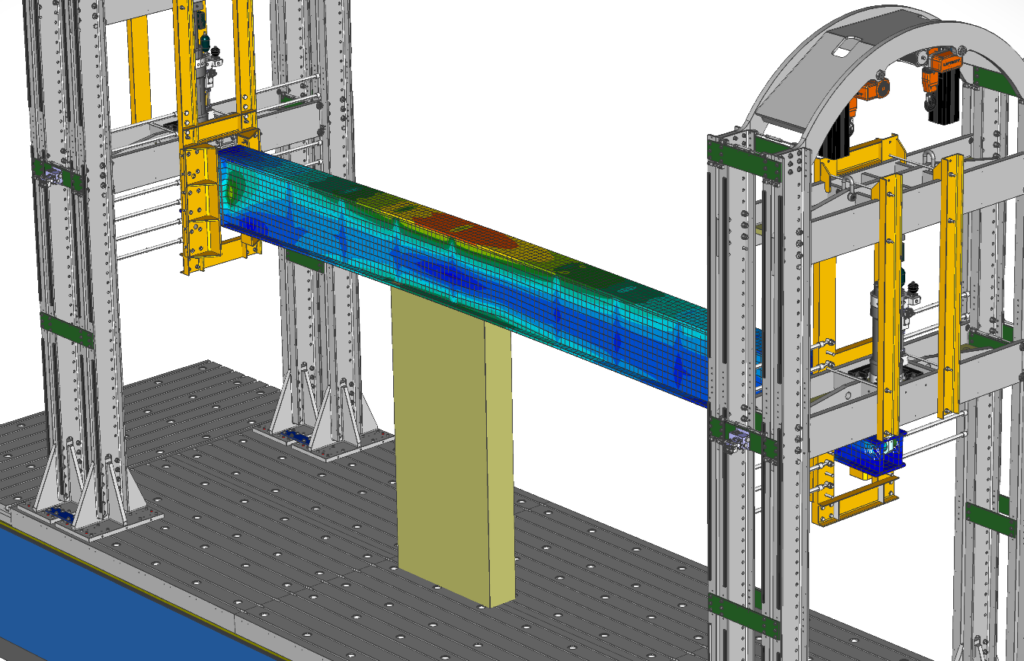
The loading frame includes two hydraulic cylinders, each generating a compressive force of 500 kN. The maximum distance between the cylinders can be 12 meters, which imposed significant structural design requirements.
Three key load cases were examined in the beam dimensioning process:
1. 1000 kN point load
2. Two 500 kN point loads
3. Continuous load of 556 kN/m over a span of 1800 mm
The structural strength analysis was carried out by combining analytical calculation methods with the Finite Element Method (FEM) for more detailed structural simulation, ensuring the safe performance of the structure under all evaluated loading conditions.
Testing System
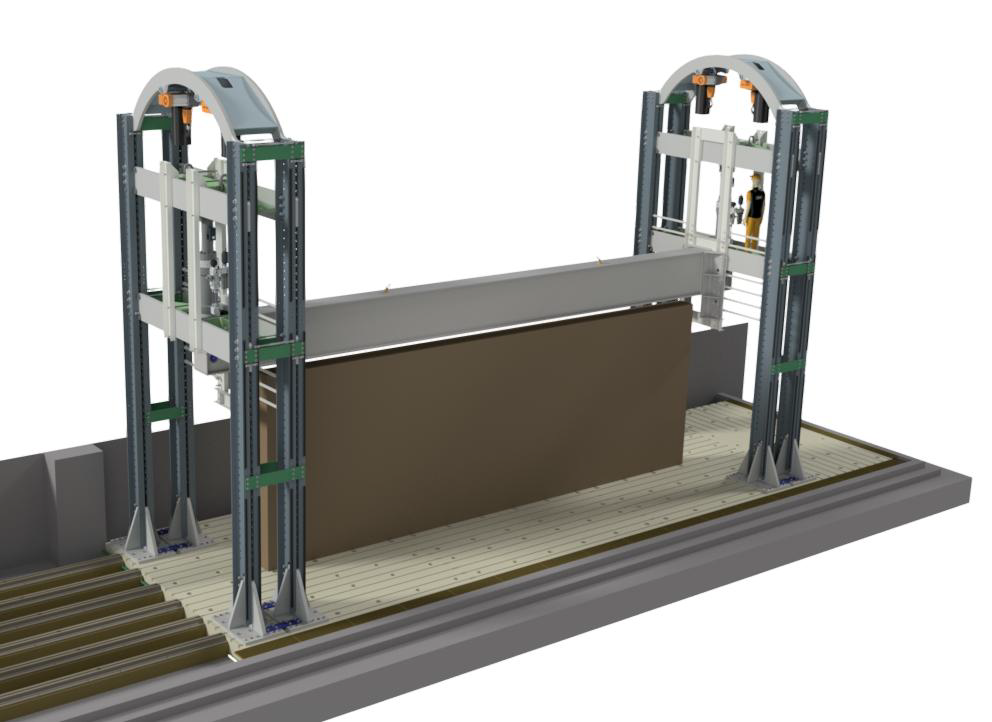
To prevent beam buckling and provide lateral support, separate H-frame support structures were designed for the system. These are attached to the existing loading frame structures.
The testing system consists of two loading frames, each equipped with one double-acting hydraulic cylinder. The piston rods of the cylinders are connected to the beam using pinned joints.
Free movement of test specimens and personnel at floor level was enabled by designing spring pack mechanisms, which allow the secondary axial loads generated during testing to be transferred to the steel structures in a controlled manner at all hydraulic cylinder positions. In addition to the practical benefits, the spring pack solution significantly simplified the beam support structures. The system enables testing and analysis of:
- Deflections
- Ultimate Strength
- Dynamic behavior
The large testing area and the load capacity of the frames make it possible to perform versatile mechanical testing and analysis of various wall, floor, and roof structures.
Design Objectives
Four key objectives were set for the design:
- Sufficient strength
- Good usability
- Manufacturability
- Optimized material usage
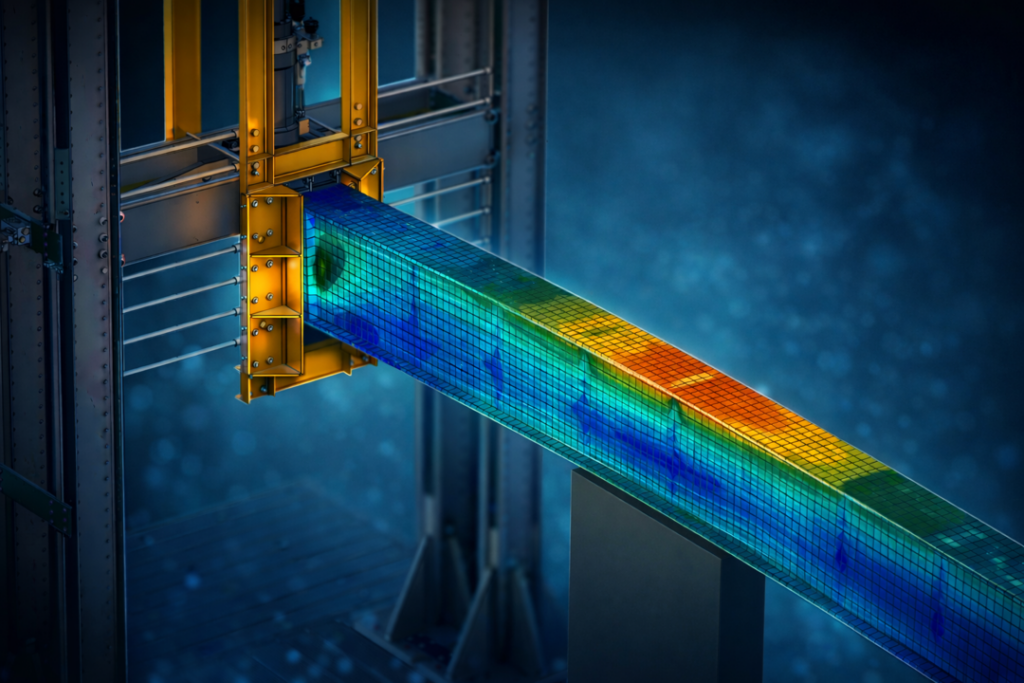
Due to the high testing loads, structural durability was one of the most important design criteria. The beam geometry and dimensions were initially selected based on analytical calculations, utilizing optimization of beam dimensions according to cross-section classes. After this, the beam’s load-bearing capacity and the need for local reinforcements were efficiently determined using the Finite Element Method (FEM). Analysis of the beam structure modeled with shell elements also enabled accurate stability assessment of the beam.
Through finite element analysis, more precise numerical values were obtained for both the locations identified as most critical for fatigue and for the load factors of different buckling and instability modes than would have been possible using purely analytical methods. Where applicable, Eurocode standards were applied in the structural dimensioning..
Ari Mielo, who works as a Research Engineer in the laboratory, was pleased with the final support solution:
“The lower part of the beam remains unobstructed, making the test structures easy to install and dismantle.”
Niko Kinnunen also praised the functionality of the solution:
“Thanks to the well-designed overall solution, the beam installation was completed better and faster than expected.”
Manufacturability and Welding Design
As this was a large steel structure containing a substantial amount of welding, weld dimensioning was a key part of the design process. Weld sizing directly affects, among other things:
- Manufacturing labor time
- Quantity of welding consumables
- Deformations caused during welding
For example, by dimensioning attachment welds according to the actual load requirements, significant savings were achieved in the beam’s longitudinal weld seams (60% reduction, equivalent to 20.8 kg of welding consumables). In addition to weld sizing, the welding sequence was also carefully planned. The welding sequence was specified in the manufacturing drawings to ensure that the fabrication process would be as controlled and efficient as possible.
Material Usage Optimization
Although material optimization was not the primary objective of the project, carefully executed strength calculations and iterative design cycles enabled a significant improvement in material efficiency.
Fanny Malmstedt states:
“Through calculation, the beam weight was reduced by nearly 45% from the original estimate. In a structure of this size, the optimization resulted in significant cost benefits.”
Project Results
As the final outcome of the project, an integrated load beam was delivered for the testing system, meeting the requirements of both research use and industrial-scale testing. Key achievements:
- Structure enabling test loads of up to 1000 kN
- Structural mass reduced by 45% from the original estimate
- Fast installation and dismantling of test structures thanks to the unobstructed floor-level workspace
- Steel structure optimized for manufacturability
- Reliable and safe testing solution for a research environment